Skip to content
Earthquake Information

Earthquake Information

wiki.geodialog.com

  • Home
  • About
  • Glossary
  • Categories
    • Seismicity
    • Ground Motion
    • Hazard
    • SandBox
    • Earthquakes
    • US
    • Geodetic
    • Glossary
    • Tectonics
    • Subduction
  • Analytic Site
  • Toggle search form

User-Based Global Earthquake Scenarios for Ground Motion Analysis

Posted on May 5, 2025April 25, 2026 By geoeditor

  • Sandbox: Create a Crustal Fault Database
  • Sandbox: Construct Earthquake Scenarios and Conduct Ground Motion Analysis
  • Documentation: Create a Crustal Fault Database
  • Documentation: Construct Earthquake Scenarios
  • Documentation: Conduct Ground Motion Analysis

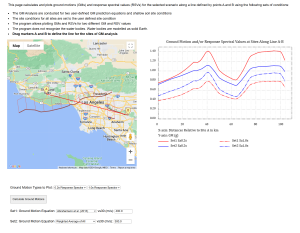
The sandbox modules on this page are designed to allow users to define crustal earthquake scenarios worldwide to conduct ground motion (GM) analysis at their sites of interest. The practical applications of this capability are:

  • Estimate the GMs of real-time earthquakes at different locations with different site conditions, soon after earthquake occurrences
  • Estimate/evaluate the GMs of future crustal earthquakes, at sites of interest, occurring in different parts of the world under different seismotectonic environments

Two modules are designed to achieve the objectives:

  • The Create a Crustal Fault Database module allows users to create a database of crustal fault segments worldwide
  • The Construct Earthquake Scenarios and Conduct Ground Motion Analysis module enables users to simulate multi-segmented earthquake scenarios worldwide to conduct GM analysis at sites of interest

The impacts of different tectonic environments on earthquakes GMs are accommodated by a logic-tree type formulation of the GM. Users can simulate different seismotectonic environments by defining weighting factors for the two GM prediction equations (GMPEs) branches:

  • One GMPE branch represents active-tectonic environments, consisting of four GMPEs as recommended by the USGS for the western US
  • The other GMPE branch represents stable tectonic environments, consisting of seventeen GMPEs as recommended by the USGS for the eastern US
Ground Motion

Post navigation

Previous Post: Constructing Earthquake Scenarios for GM Analysis
Next Post: Geodetic Data and Regional Seismicity

More Related Articles

Ground Motion Components Ground Motion
Earthquake Ground Motion and Response Spectral Analysis: Technical Details Ground Motion
Constructing Earthquake Scenarios for GM Analysis Earthquakes
Earthquake Ground Motion and Response Spectra Ground Motion
Ground Motion Analysis for User-Defined Earthquake Scenarios Ground Motion
Creating a Crustal Fault Database Earthquakes

All Posts

  • Building Seismicity Model
  • Cascadia
  • Characteristic Earthquakes
  • Comments and Suggestions
  • Construct Regional Seismicity Models Using Geodetic Strain Rate
  • Constructing Earthquake Scenarios for GM Analysis
  • Creating a Crustal Fault Database
  • Earthquake Ground Motion and Response Spectra
  • Earthquake Ground Motion and Response Spectral Analysis: Technical Details
  • Earthquake Hazard Analysis
  • Earthquake Hazard Issues and Analytical Tools
  • Geodetic Data and Regional Seismicity
  • Global Earthquake Distribution
  • Glossary List
  • Ground Motion Analysis for User-Defined Earthquake Scenarios
  • Ground Motion Components
  • Gutenberg-Richter Distribution: Technical Details
  • Interactive Modules
  • Post Gutenberg-Richter Magnitude Rate Distribution: Technical Details
  • Probabilistic Seismic Hazard Analysis: Technical Details
  • Sand Box Guide: Earthquake Hazard Analysis
  • Seismicity of the United States
  • Tectonic Plates
  • User-Based Global Earthquake Scenarios for Ground Motion Analysis
  • USGS Earthquake Scenarios for Faults in Western US
  • USGS Seismicity Model: Faults in the Western US

Copyright © 2026 Earthquake Information.

Powered by PressBook Premium theme