Constructing a seismicity model, in a nutshell, means formulating a realistic model of earthquake occurrences on a fault, in a subduction zone, or within an area. A modeler would collect:
- Regional historical and instrumental earthquake data to constrain the rates of occurrence of small to moderate-sized earthquakes
- Regional seismotectonic information to understand the causative forces straining the region
- Regional, fault, and subduction zone-specific geodetic data to quantify the annual rate of straining that is driving the future occurrences of earthquakes
- paleoseismic, paleo-liquefaction, and paleo-tsunami data, if relevant and available, to augment the frequency and severity of past large earthquakes
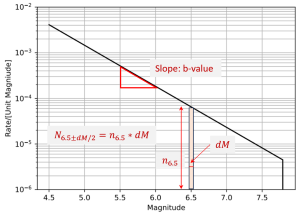
Most seismicity models are formulated as a combination of a Gutenberg-Richter (GR) and a characteristic earthquake model. The Gutenberg-Richter model describes the occurrence of earthquakes on a fault, within a subduction zone, or within a region as an exponentially decaying function of magnitude. The GR model often is a good representation of seismicity for large regions. However, for most faults and subduction zones (FSZ), the seismicity pattern is more complex. Often, large magnitudes in FSZ do not follow the typical GR model. For this reason, seismologists often use the concept of a characteristic earthquake (ChE) model to capture the occurrence of large magnitude earthquakes in the FSZ. Figure 1 illustrates these two concepts:
- The red line shows a GR distribution, where seismicity follows a smooth exponential curve.
- The blue line shows a hybrid GR + ChE distribution, representing a more complex scenario.
For details on these models, see the linked resources above.
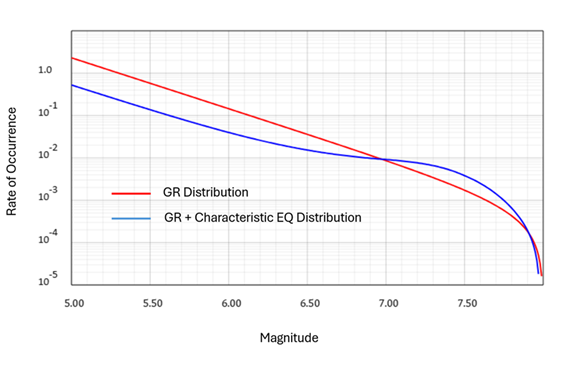
Figure 1.