- Sand Box: Ground Motion & Response Spectral Analysis
- Earthquake Ground Motion and Response Spectral Analysis: Technical Details
Accurately estimating earthquake ground motions and response spectra is a fundamental part of earthquake hazard analysis. Over the past several decades, engineering seismologists have developed a variety of physical and empirical models to support this task. These models are known as ground‑motion prediction equations (GMPEs). Although widely used in practice, GMPEs are often mathematically and conceptually complex. They draw on scientific understanding of how earthquakes generate ground motions, how seismic waves travel through the crust and shallow soils, and how structures respond to those motions.
Because GMPEs combine many different physical processes, it can be challenging to see how each component—source behavior, wave‑propagation effects, and local site conditions—contributes to the final ground motions and response spectra observed at the surface. The purpose of this page, the accompanying link, and the interactive Sand Box is to help users build intuition about these building blocks. By experimenting with simplified models, learners can better understand how source, path, and shallow‑soil parameters influence surface ground motions and structural response.
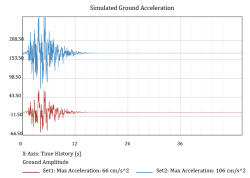
Figure 1 shows the Sand Box interface. This module simulates ground motions and response spectra for two sets of virtual earthquakes. Users can adjust the following parameters:
- Magnitude — a source parameter
- Stress drop — a source parameter
- Quality factor (Q) — a regional wave‑attenuation parameter
- Kappa (κ) — a local crustal damping parameter
- Shallow soil conditions — local site parameters
More detailed explanations of these parameters are available through the technical link.
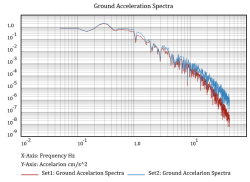
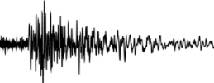
Simulation results appear in two panels. The upper panel displays the ground‑motion time history, while the lower panel shows the surface response or response spectra. When ground acceleration or velocity is selected, the lower panel presents the Fourier Transform of the corresponding surface motion.
Time histories are generated using the random vibration technique (RVT) as formulated by Boore (1983). The “Randomized Time History” button produces a new simulation each time by changing the underlying random number set. In contrast, the “Fixed Time History” button uses the same random number set for all simulations. This feature allows users to separate the effects of model parameters from the randomness inherent in time‑history generation, making it easier to see how each parameter influences the resulting ground motions and response spectra.

Figure 1.